Design journal 001 ·
When an eight-kilometre-wide world begins to rotate
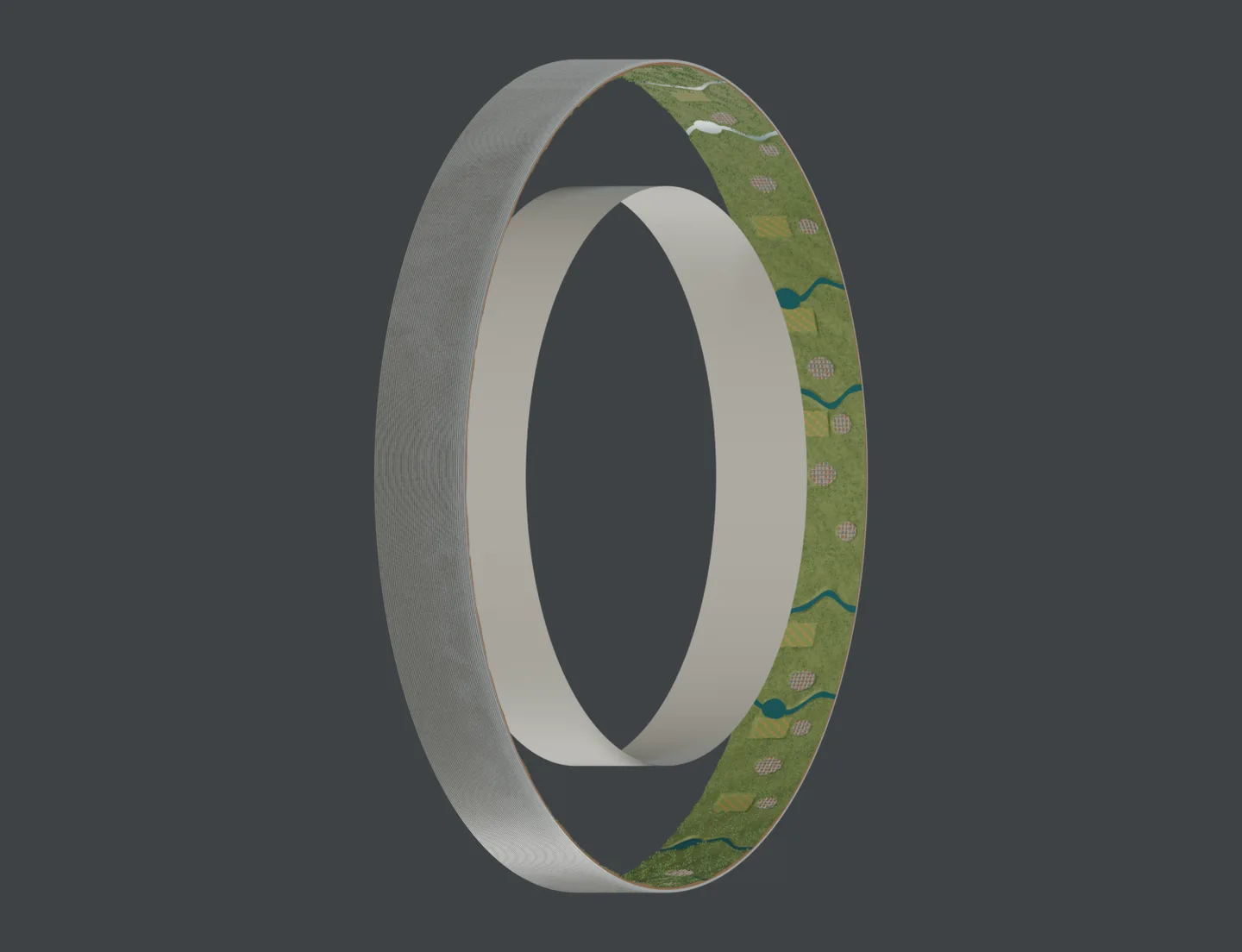
Could a landscape in space feel like Earth? We are studying a one-kilometre-long segment of a rotating ecological habitat, exploring how artificial gravity, the landscape and the cylindrical shell relate to one another.
- Rotation period
- 126.67 s
- Rotations per minute
- 0.474 rpm
- Ground-level gravity
- 1.00 g
01
A world that turns once every two minutes
Artificial gravity follows the relationship a = ω²r. With an outer cylinder inner diameter of 8 km and a reference soil depth of 14 m, the reference ground radius is 3,986 m. To reach standard Earth gravity (9.80665 m/s²), the habitat would rotate approximately once every 126.67 seconds, or 0.474 revolutions per minute.
The ground's tangential speed is about 712 km/h relative to the axis, not relative to its inhabitants. If the cylinders share the same angular velocity, the inner cylinder's outer surface, at a radius of 2,800 m, would experience around 0.70g. A hill rising 21 m inward would still experience nearly 0.995g.
02
Why the shell cannot be treated as an ordinary pipe
The structure must carry air, soil and its own rotating mass. For an illustrative calculation, we assume a 7.5 m steel shell, 14 m of soil at 1,800 kg/m³, steel density of 7,850 kg/m³ and ground-level atmospheric pressure of 101.325 kPa. The table below estimates the average circumferential tensile stress of an idealized smooth shell.
The largest contribution in this scenario is the shell's own rotation. Extra metal is not free: it increases the rotating mass as well as the available load-bearing area. With ideal load sharing between the shell and the current continuous ribs, the estimated average stress falls from about 495 to 446 MPa, while metal mass increases by roughly 36%. This comparison does not establish the actual local stress or structural safety.
| Load source | Estimated stress |
|---|---|
| Rotation of the steel shell | ≈ 309 MPa |
| Reference soil layer | ≈ 132 MPa |
| Atmospheric pressure | ≈ 54 MPa |
| Total without ribs | ≈ 495 MPa |
03
Continuous rings or a triangular grid?
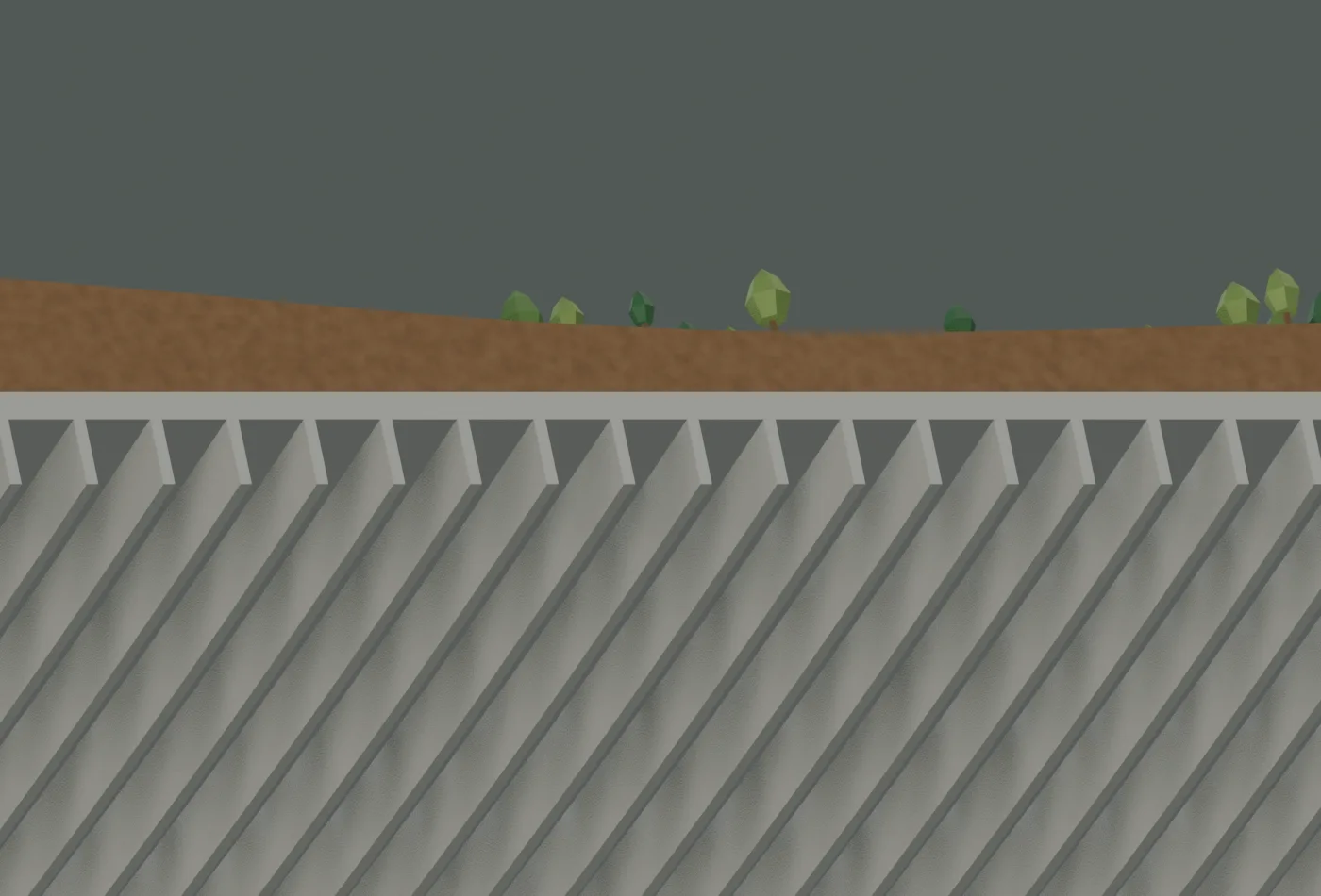
A continuous ring provides a direct circumferential load path. Longitudinal members could address axial loads, while a triangular grid is worth exploring for multi-directional loads and shear. We retain continuous rings as the current concept and consider alternatives under comparable mass, material and loading conditions.
The relative strength-to-weight ratio of materials may matter as much as the reinforcement geometry. A more complex-looking structure is not automatically a better one.
04
Making the scientific questions visible
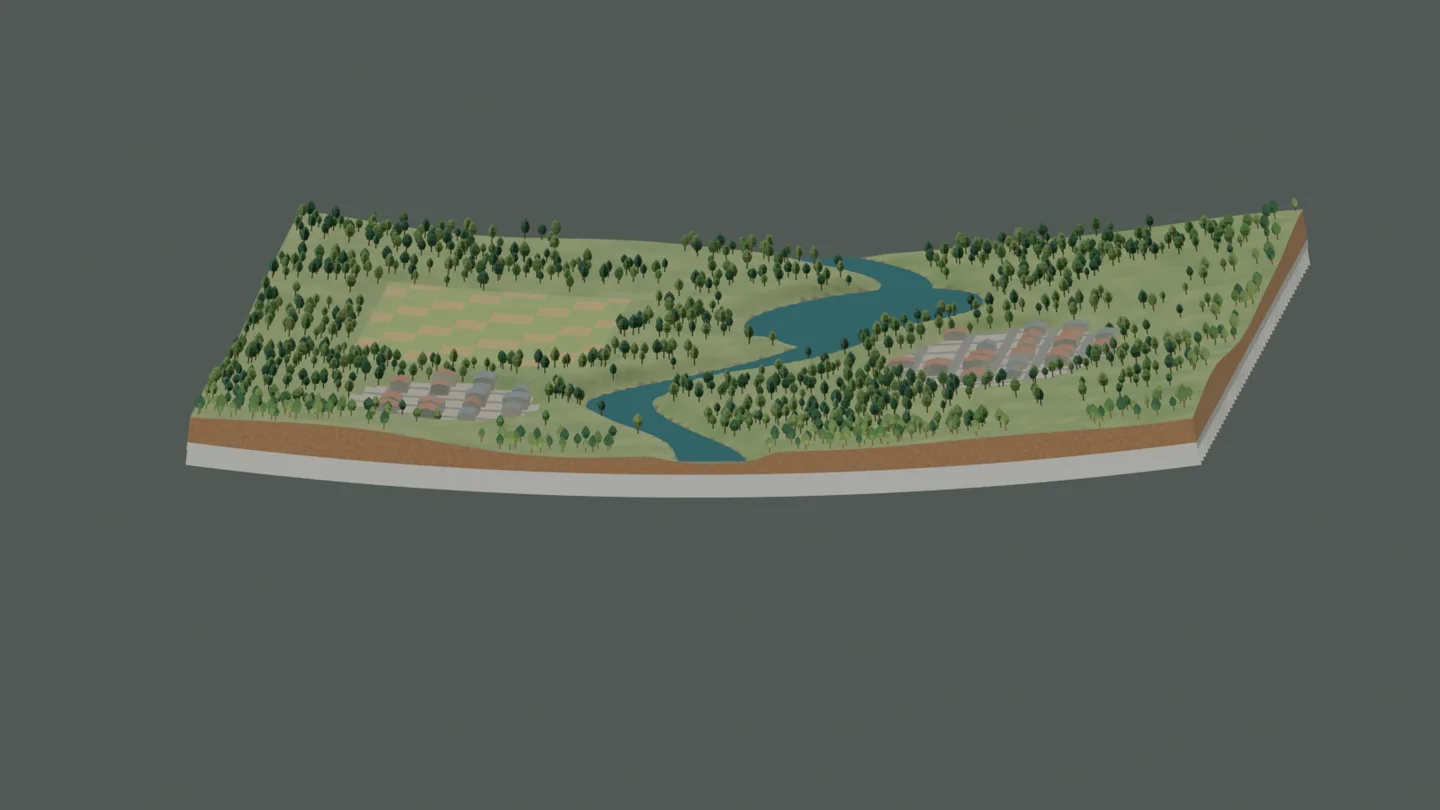
The digital model concentrates on a single 1 km segment. Its curved land, rivers, forests, settlements and exterior ribs are derived from one spatial concept. Each iteration can reveal a new question about scale, material or how people might experience an artificial world.